
For a long time, I believed that if we wanted to solve the hard problems of the world — poverty, homelessness, political polarization or teenage depression — I would need to work within the non-profit sector.
But I struggled with that idea.
I did not want to spend my life asking people for money. At the same time, I also did not want to simply make a lot of money and give it away later. I wanted to get my hands dirty.
Redemptive entrepreneurship brought these two worlds together for me through the framework of redemptive business.
At its core, redemptive business means designing a company to have a specific impact on the world, and then using profit to sustain and scale that impact.
The business exists for impact. Profit serves the mission.
This is the opposite of companies using social impact as a marketing strategy to increase profit.
A helpful analogy is oxygen. Humans will die without oxygen, but we do not live in order to breathe. In the same way, profit is the oxygen of business: necessary, but not the goal.
The aim of redemptive business is to pursue what God wants done where we live and work, often involving sacrifice.
The Redemptive Framework
The organization Praxis describes three ways businesses and non-profits tend to operate.
Exploitative — I Win, You Lose
A company profits at the expense of others.
Think doom scrolling. Social media platforms gain advertising revenue while users lose sleep, focus and well-being.
Ethical — I Win, You Win
Most good businesses operate here.
For example, when you call a plumber during an emergency, the plumbing company earns a higher wage; you avoid water damage.
Redemptive — I Sacrifice, We Win
Redemptive entrepreneurship goes a step further.
Instead of only avoiding harm and creating fair exchange, the business intentionally absorbs additional cost or difficulty in order to restore something broken in the world.
For example, a coffee company might intentionally source beans from a village facing human trafficking. The beans may cost more but the supply change protects vulnerable families. (See REBBL’s Founding Story .)

A Simple Example: Trades and “Gleaning”
Imagine a Christian business owner who feels called to address poverty.
They recognize that providing another meal or pair of socks may help in the moment but may not address deeper root causes.
After prayer and reflection, they may conclude the people need dignified work that pays.
One possible response could come through skilled trades.
A construction company might create periodic “clean-up days” where people living in shelters or refugees could work for a day alongside trusted support workers.
A traditional non-profit model might coordinate these opportunities across multiple companies.
A redemptive business would approach it differently.
Instead of coordinating the work externally, the entrepreneur would build a construction company with a high level of excellence, and employment pathways for the marginalized as part of its mission.
They might still host “clean up days” within the company, but would continually look for new and innovative approaches to care for the poor and foreigners among them.
This kind of thinking reflects the heart behind God’s gleaning laws in Leviticus 19:9-10, where farmers were instructed to leave portions of their harvest for the poor and the foreigner (Read more about gleaning at GotQuestions.org )
My own Journey in Port Alberni
My personal calling centres on two things:
-
Pursuing church unity in Port Alberni (on Vancouver Island)
-
Feeding the hungry
After graduating top of my Computer Science class at Simon Fraser University , I felt compelled to return to Port Alberni for several years, take over my father’s website business, and learn to address poverty locally.
Taking over the business was overwhelming at first. If you want to discuss wrestling with email response times, managing staff for the first time, or learning how to reconcile credit card statements on QuickBooks, let’s rant chat.
But alongside building the business, I began trying to understand poverty in my community and seeking to address it as a redemptive entrepreneur.
Port Alberni had nearly the highest income per capita in Canada in the 1970’s. By 2020, however, Port Alberni’s median after-tax household income had fallen to nearly a third the national average. In 2021, violent crime was almost double the provincial average, ( Statistics Canada 2023 ).
Among Port Alberni’s homeless population, 66% identified as Indigenous in 2023 and 49% in 2025, despite Indigenous people only making up about 15% of the city’s census population (BC Housing, 2023 & 2025 ).
Shortly after returning to Port Alberni, I met with the head of the local Salvation Army, Major Michael Ramsay, and he asked me what ideas I had to address poverty. I told him I had a hypothesis, but I wanted to take an entrepreneurial approach.
In entrepreneurship, we often try to get close to the “customer” first to understand their needs, hopes and obstacles before coming up with any ideas. In this case, the “customer” is the people we are called to serve, whether those paying us or, in my case, people facing material, social or spiritual poverty.
The Major invited me to eat at the soup kitchen, listen to people’s stories, and build relationships.
I also chose to live and work half a block from the soup kitchen on 3rd Ave. What the Downtown Eastside is to Vancouver, is 3rd Ave to Port Alberni.
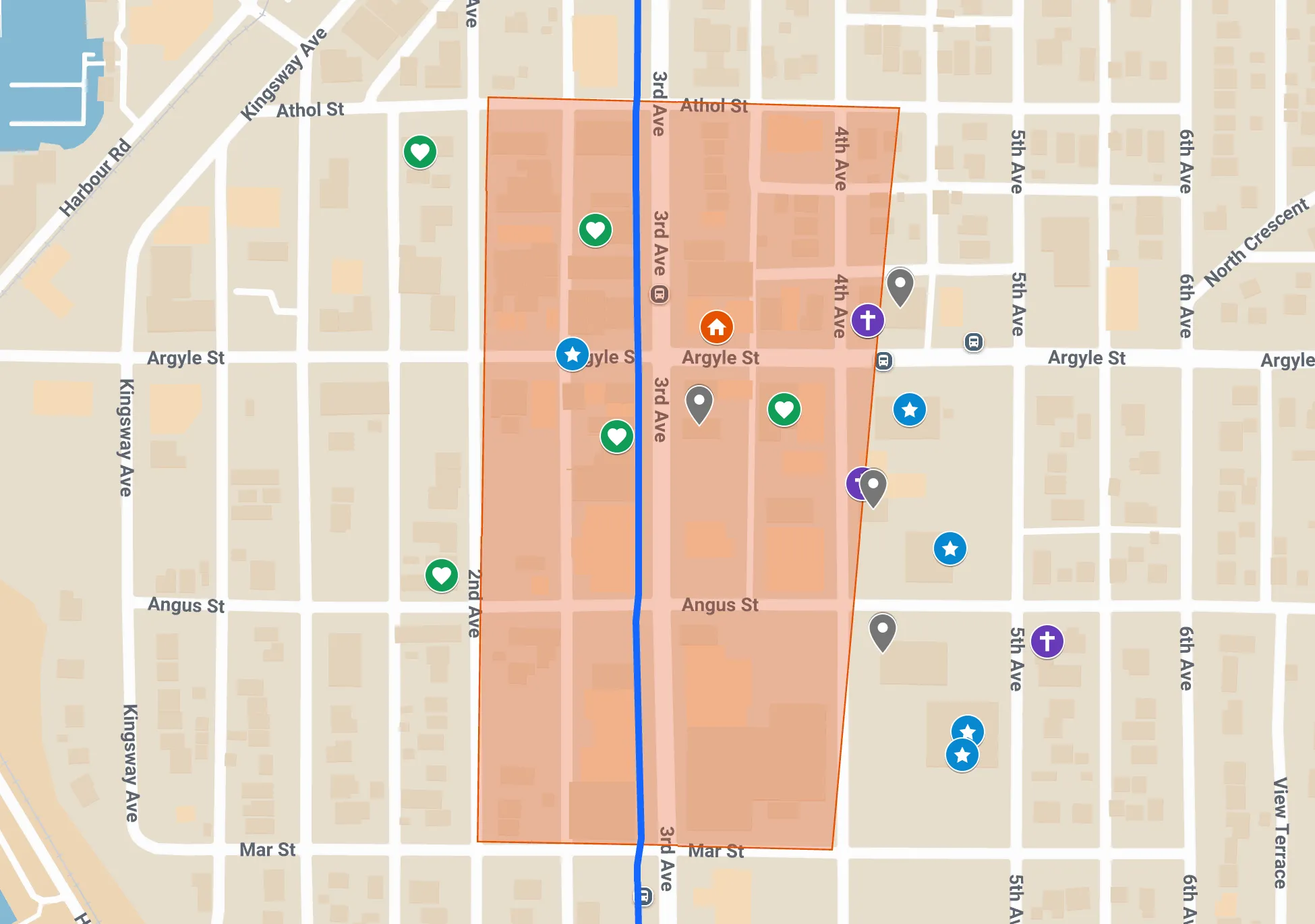
I live above my office at the red home icon. The non-profits related to poverty or marginalized are the green hearts. The soup kitchen (Bread of Life) is along 3rd Ave and above Argyle (to the top left of my home).
For nearly two years I prayed, listened, and spoke with community leaders and people experiencing poverty.
Through these conversations I began forming a different view of how poverty might be addressed locally.
While public conversation often emphasizes housing and mental health first, I increasingly believe trusted community and meaningful employment need to come first.
Rather than trying to change government policy, my focus as an entrepreneur is to innovate within the system we have.
What I’m doing now
Today I’m experimenting with ways to build trusted community in Port Alberni.
One way is organizing community dinners that bring together people from across Port Alberni: rich and poor, the First Nations and other nations in Canada, young and old.
Later this month, our volunteer team will host our second Community Easter Dinner in partnership with the Port Alberni Friendship Center.
I am also exploring ways that the Alberni Christian Village could provide farm based day jobs and possible housing for those connected to the Bread of Life.
When redesigning Alberni Online’s website, however, I realized something important.
Alberni Online itself is not a redemptive business.
After months of prayer and discussion with my designer, Jenny, I concluded that its role is different. Alberni Online is helping me learn how to run a healthy business.
The next business I build, possibly a street cleaning service on 3rd Ave, may be a redemptive business.
The Ongoing Goal
According to Hart ( Praxis Journal 2020 ), the aim is to:
-
Attack the exploitative
-
Baseline the ethical
-
Chase the redemptive
These postures apply to:
-
Strategy — what we build
-
Operations — how we build
-
Leadership — why we build
When businesses pursue this path, they can begin restoring people, communities and systems where they operate.
Continue the Conversation
There is much more to explore about redemptive entrepreneurship.
If this article has sparked your interest, the resources below are a great place to continue learning. I would also love to discuss what redemptive business might look like in your context or just business in general. Let’s Chat.
Resources
Explore the Redemptive Framework
Read the Redemptive Business Playbook
Watch a short video explaining the framework